Vivere in modo autentico attraverso l’arte: il percorso creativo di Ava Margueritte
Ava Margueritte is a photographer and multidisciplinary artist whose practice explores the intersections of identity, disability, and renewal. Formally trained at both OCAD U e SPAO, she balances technical precision and conceptual depth. Format sat down with Margueritte to talk about securing her first major grant, exhibiting two back-to-back solo shows, and the development of her series Landfall.

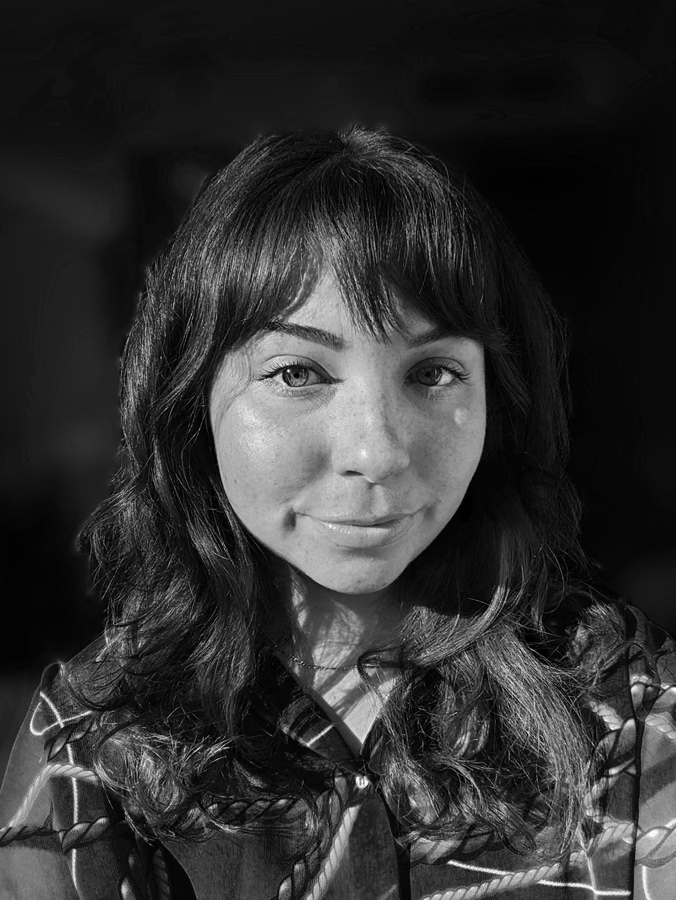
Photographer and multidisciplinary artist Ava Margueritte.

A Leap Toward Authenticity
Photographer and multidisciplinary artist Ava Margueritte has shifted course, redefining her career and transforming her practice and life.
Leaving behind a full time job to dedicate her focus to photography, a year and a half in she’s developed a rhythm in her practice, full of intention and care. Translating lived experience into a visual language, her work is quiet and contemplative as it explores the intersections of identity, disability and renewal. In giving herself the freedom to create, Margueritte has also given herself permission to live authentically—as an artist and as herself.
Formally trained at the Ontario College of Art & Design University and later at SPAO: School of Photographic Arts Ottawa, Ottawa-based artist Margueritte demonstrates a balance of technical skill and conceptual inquiry in her work. As a longtime Format member, she spoke with us about how she’s learning to live a creative life on her own terms.

Translating Experience: Personal Narrative in Photography
Your work is deeply personal—a blend of self-reflection and observation. What draws you to turn that gaze inward?
I think I’ve always been curious about how the internal becomes visible—how something felt can live in a photograph. My work started from that need to translate things I didn’t have words for: memories, anxieties, small moments of clarity. The camera became a way to communicate what my mind couldn’t always express directly.
Over time, that process of looking inward started to feel like a kind of homecoming. Each project teaches me something about how to live in my own rhythm—to accept the parts of myself that used to feel too quiet or too much.

Una guida per migliorare le vostre abilità fotografiche
Migliorate la vostra fotografia con la nostra guida gratuita. Ottenete l'accesso esclusivo a suggerimenti, trucchi e strumenti privilegiati per perfezionare il vostro mestiere, costruire il vostro portfolio online e far crescere la vostra attività.
Ricevi il meglio della rivista Format nella tua casella di posta elettronica.

Neurodivergence & Creativity
How do you see your neurodivergence influencing the way you think and work as a creative?
I have a few learning disabilities—dyslexia, ADHD, CAP-D (Central Auditory Processing Disorder)—and a lot of those are more fluid than a 9 to 5. I was struggling being confined to structures that didn’t work with my inner being.
I’m more of a burst worker; I’ll work really hard for a few weeks and then work a little less for, say, the other two. Trying to keep up with a rhythm that was out of sync with my own rhythm was very draining. Being able to work more freely has actually allowed me to feel more creative and take care of myself in a way I didn’t always feel like I could.
From what I’ve observed, I think a lot of people who are on the spectrum and who struggle to fit into that world feel a lot of internal shame…There are things I’m really good at, but there’s a lot of shame that comes with it and it starts really young—from having an IEP (Individualized Education Program), or not having access to resources.
A lot of my late twenties was finding a way to be okay with this part of myself that is uncomfortable and still not really recognized. There’s still stigma around it. But I was making work about it anyway. You can’t hide from it in a corporate setting, and I was trying to unlearn that feeling of shame.


Risks, Rewards, and Letting Go of the Corporate World
What led you to make the leap to pursuing your photo practice full-time?
Moving full-time as an artist, and fully dedicating myself to my practice, wasn’t an easy decision—but it felt very necessary. There were a lot of recurring themes in my life. I found a lot of the skills I was using for my job, I was also using for my own practice, so I was able to translate a lot of them. But I also learned a ton in every role and every job that I was in.
I had been slowly building my own practice over about ten years, but I found that I didn’t have the same energy and dedication to pour into my work. So I made the difficult decision to leave my job and put all of myself, and all my work, into what I was doing.
I’ve been building relationships in Ottawa for close to seven years now, so I was able to make that transition a bit more easily since a lot of what I was doing, I was already doing alongside my work anyway. It became more about applying what I was already doing to my practice full time.

Big Ideas Become Bold Portfolios
Inspired by Ava’s story? Start building your own creative portfolio today with Format’s free trial.
Experience the platform trusted by artists like Ava to showcase, grow, and evolve their practice.
Finding Stable Ground and Overcoming Self-Doubt as a Professional Photographer
What helped you stay grounded while you were building momentum in your practice?
Transitioning from a job to doing this full-time on my own was scary, but I think the hardest thing was actually taking a break. I’d been working so long in such a way that slowing down and listening to myself—knowing when I needed a break and not pushing through—was hard. There was that constant feeling of failure: I’m not doing enough, I should be doing more.
My mom is a businesswoman, my partner works in that world, and I started reframing my thinking to see it as a business. Give yourself two years before it’s a failure. You’re putting all your eggs in this basket for two years. Right now I’m just under a year and a half in, and this is my first month where I’ve had five photoshoots lined up. I just got my first major grant. I’m having two back-to-back solo exhibitions. I did my first artist residency. Things started to take off a year after I committed to my practice, which is really a year of giving my full attention to it.
It took that long, and it took applying to 30 applications. I wanted everything to happen immediately because I’d been doing my work for so long, but there’s so much that goes on behind it. Reframing it—like, if you start a business, you expect to go two years without a salary—really helped. You lay that groundwork so when it does come, you’re ready. For me, it’s happening, and it feels surreal.

Exploring Identity and Impermanence Through the Lens
How do your personal experiences influence the subjects you explore in your photography?
Themes I’m currently exploring in my practice are my own comfort and discomfort with what’s familiar and what is foreign. I often look at time, impermanence, and identity, and blend those together. I’ve just completed—or I’m extending—a project called Landfall that looks at binaries within society.
From my own experience being neurodiverse and having mental health challenges, I’ve contained and looked at those and applied them to this body of work. I’m looking at the fluidity of nature contrasted by the rigidity of society to express my own navigating of my human experience as a neurodiverse individual. It’s like I’m looking at this world that I don’t really understand and don’t really feel like I fit in all the time.
I identify with nature and feel like I’m up against something that feels hard. So I use people and the natural environment to represent these themes. The images are structured, fluid and beautiful, with a tinge of a haunting/moody quality.Someone recently described my work as having a sense of “impending doom,” and at least that’s something. I like the idea that you’re on the edge of something—that someone can look at my work and say, “Yeah, it’s beautiful, but are you okay?”. It’s a form of recognition and quiet connection and a feeling of being seen.


Building Connection Through the Camera
What role did your relationships play in shaping your series, Landfall, and how did it feel to turn the camera toward people you know so intimately?
When I was working 9 to 5, I was really struggling. A lot of my relationships had fallen to the wayside. Landfall was really about reconnecting with my community. I spent a lot of time rebuilding relationships and connecting with people.
Photographing someone is really special and quite intimate. There’s this relationship between the subject and me—we occupy the space together where we get to just exist in something that kind of matters but kind of doesn’t. It’s a moment of intimacy where I get to gaze upon my subject; I feel like my subject gets to be seen in a way you’re often not seen. I get to understand you.
There’s a moment when I look through my viewfinder where you feel it and you just know you have the shot. This project was really about connecting with people I hadn’t had the energy for. I’d been so wrapped up in the daily needs of my job that I had nothing left to pour into other relationships, and this was a beautiful way to reconnect…It felt like an apology: “I’m sorry I haven’t been here for years.” It’s trying again, documenting, being present and quiet, and getting to know someone over a couple of hours.

Lessons in Making Art on Your Own Terms
What lessons have you learned through this journey of building a practice that fits your needs?
I always knew it was in here, like I just had a feeling. And I think it’s about listening to that—especially when you don’t fit in. For so long I wanted that normal life, the 9-to-5, the stability. I wanted to fit in and be like everyone else. But there was always this little voice saying, “Come on, photo is what you’re meant to be doing.”
It’s hard, and it’s a lot of work, and it never really stops. But I’ve learned that breaks are okay. My mom gave me this advice when I started doing this full-time: she said, “Any time you go and take photos, that counts as working.” Because for so long I had been doing it outside of my job, and it didn’t register as work—even though that’s what I loved most.
Doing what you love is still work. It just looks different. It doesn’t fit neatly into a schedule. And that’s okay.


Growing With Format: A Decade of Creative Evolution
You’ve been part of the Format community for more than a decade, growing creatively throughout that time. How do you see your practice today compared to when you first started?
When I think back, it’s wild to realize how long I’ve been building with Format—over ten years. My portfolio website has grown with me through every stage of my practice. When I started, I was juggling part-time jobs and building my art on the side. I didn’t know yet what it would look like to commit fully. But each project, each update to my site, became a record of growth—not just artistically, but personally.
Looking back, I see that consistency as a kind of quiet backbone. It reminds me that becoming an artist wasn’t one big decision—it was hundreds of small choices over time, all leading here.

Watch Ava’s video interview below:
Costruite il vostro portafoglio con Format
Il costruttore di portfolio online #1 è stato valutato da artisti e creatori.