

When a couple searches for a wedding photographer in 2026, there’s a good chance the first answer they see isn’t a traditional list of blue links. It’s an AI-generated summary, a direct recommendation, or a conversational response from tools like Google AI Overviews, ChatGPT, or Perplexity.
For photographers, this matters. The discovery process has shifted. Clients are still searching, but the mechanism that decides which photographers get surfaced has changed underneath the entire industry. Traditional SEO practices still hold weight, but they’re no longer the full picture.
This guide breaks down how AI search actually works for creative professionals, what it means for your portfolio and online presence, and the practical steps you can take to show up where your future clients are looking. No jargon, no hype. Just what you need to know right now.
The Search Shift: What Changed for Photographers
The short version: search engines got smarter, and the way they present results got more opinionated.
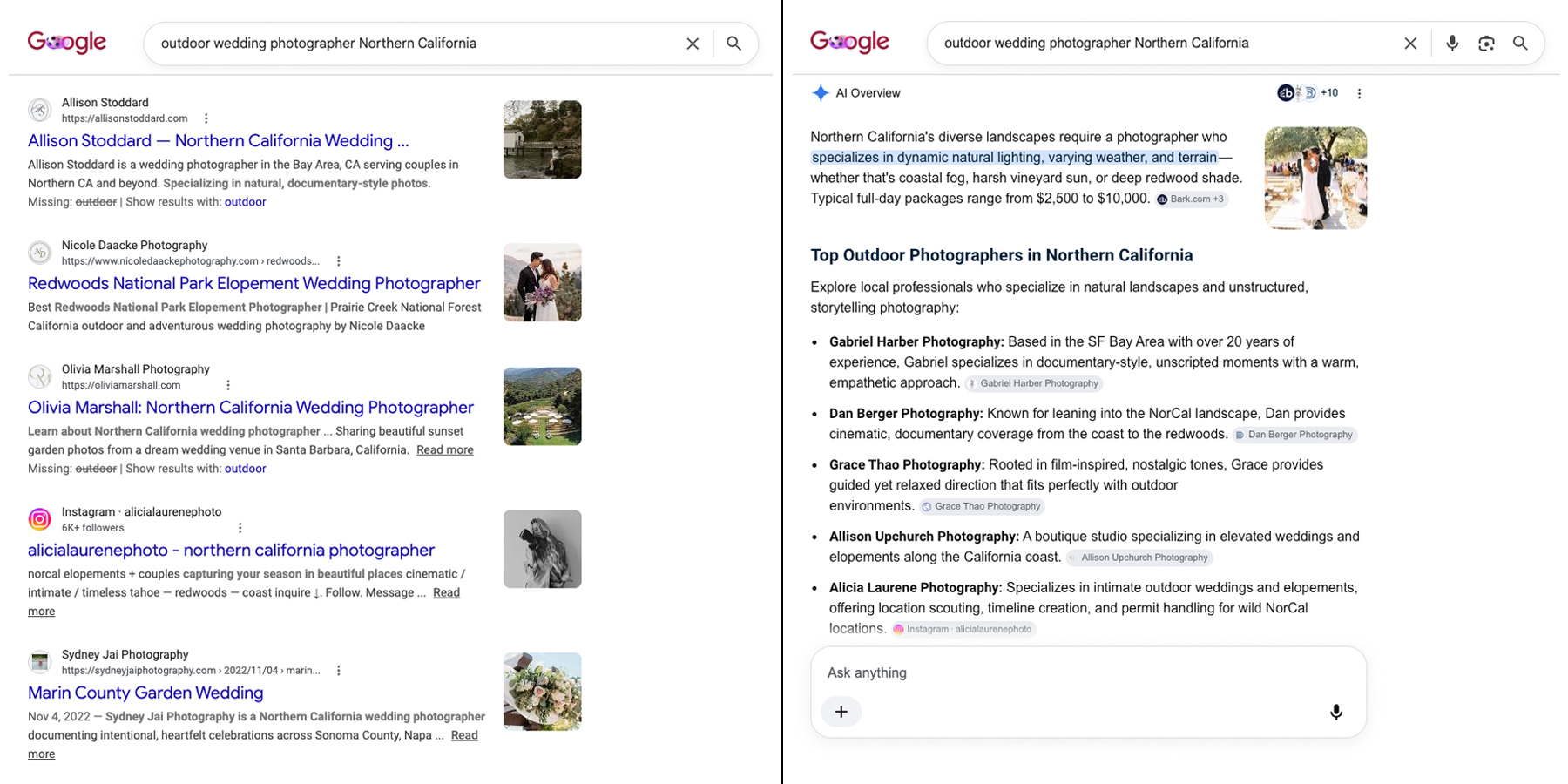
Google’s AI Overviews now appear on a significant percentage of queries, including service-based searches like “best portrait photographer in Austin” or “outdoor wedding photographer Northern California.” Instead of simply listing ten websites, Google synthesizes information from multiple sources and presents a curated answer. According to research by Authoritas, AI Overviews now trigger on roughly 30% of all search queries, with local service queries increasingly included.
Meanwhile, AI assistants like ChatGPT and Perplexity are being used as discovery tools. A growing number of potential clients are asking conversational questions: “Can you recommend a portrait photographer who does natural light work in Denver?” and receiving direct, cited answers.
What this means practically:
- Visibility is no longer just about ranking. Being listed as a source in an AI-generated answer can drive awareness even without a traditional #1 position.
- AI doesn’t just crawl. It interprets. These systems read, evaluate, and summarize your content in ways that go far beyond matching keywords.
- Authority signals matter more than ever. AI search tools prioritize sources they assess as trustworthy, experienced, and specific.
The photographers who understand this shift are already adapting. The ones who don’t risk becoming invisible to an entire generation of clients who search differently than the one before.
How AI Search Engines Find and Recommend Photographers
To show up in AI-generated answers, you need to understand what these systems are actually looking for when they evaluate your online presence.
What Makes a Portfolio “Readable” to AI
Traditional search engines could index your images and text independently. AI search tools go further. They assess the relationship between your content, your credentials, your specialization, and the geographic context of your work.
Here’s what matters:
- Clear, structured content. AI systems favor pages with well-organized headings, descriptive sections, and logical content hierarchy. If your portfolio is image-only with no text context, AI tools have very little to interpret.
- Specificity over generality. A photographer whose site says “I shoot weddings, portraits, events, commercial, and real estate” gives AI less to work with than one whose content clearly signals “documentary wedding photographer specializing in outdoor ceremonies in the Pacific Northwest.”
- Consistent information across platforms. AI tools cross-reference your portfolio, your Google Business Profile, directory listings, and social media. Consistency in your name, location, specialty, and contact information strengthens the signal.
Why Text Content Matters Alongside Your Images
This is the biggest blind spot for most photographers. Beautiful portfolios full of stunning images are critical for converting visitors into clients, but AI search tools cannot “see” your images the way a human can. They rely on:
- Alt text descriptions that accurately describe each image
- Page copy that contextualizes your work (project descriptions, location details, client context)
- Blog posts and guides that demonstrate topical expertise
- Bio and about page content that establishes first-hand experience
Think of it this way: AI search tools read your portfolio like a gallery catalog. The images get people through the door, but the written context is what makes you findable in the first place.
Generative Engine Optimization for Photographers
You may have seen the term “Generative Engine Optimization” (GEO) circulating in marketing discussions. Here’s what it actually means for photographers, and how it differs from the SEO practices you may already know.
GEO vs. Traditional SEO: What’s Different
Traditional SEO for photographers focuses on keyword placement, meta tags, site speed, backlinks, and local search signals. All of that still applies. GEO builds on top of it.
The core difference is that GEO optimizes your content not just for search engine ranking, but for AI citation and recommendation. When Google AI Overviews or ChatGPT generates an answer, it selects sources based on:
- Clarity of information. Can the AI extract a clean, factual answer from your content?
- Authority indicators. Does the content come from someone with demonstrated expertise? Is there an author bio, first-hand experience, or credentials?
- Structured data. Does the page use schema markup that makes the content machine-readable?
- Topical depth. Does this site cover the subject comprehensively, or is this a surface-level page?
For photographers, GEO doesn’t mean learning an entirely new discipline. It means being more intentional about how you present the information you already have.
Future-ready portfolios start here. Begin your free Format trial.
Structured Data and Schema Markup
Structured data is the technical layer that helps AI understand your content at scale. For photographers, the most relevant schema types include:
- LocalBusiness or Photographer schema: Tells AI your name, location, specialty, and service area
- ImageObject: Provides context for individual images, including descriptions, copyright, and creation details
- FAQPage: Marks up common questions you answer on your site, making them directly quotable by AI tools
- Review/AggregateRating: Highlights client testimonials in a machine-readable format
If your portfolio platform supports schema markup natively or through custom code, this is one of the highest-impact changes you can make. If it doesn’t, that’s a limitation worth evaluating.
Seven Practical Steps to Show Up in AI Search Results
Here’s what you can do this week. No complex tools required.
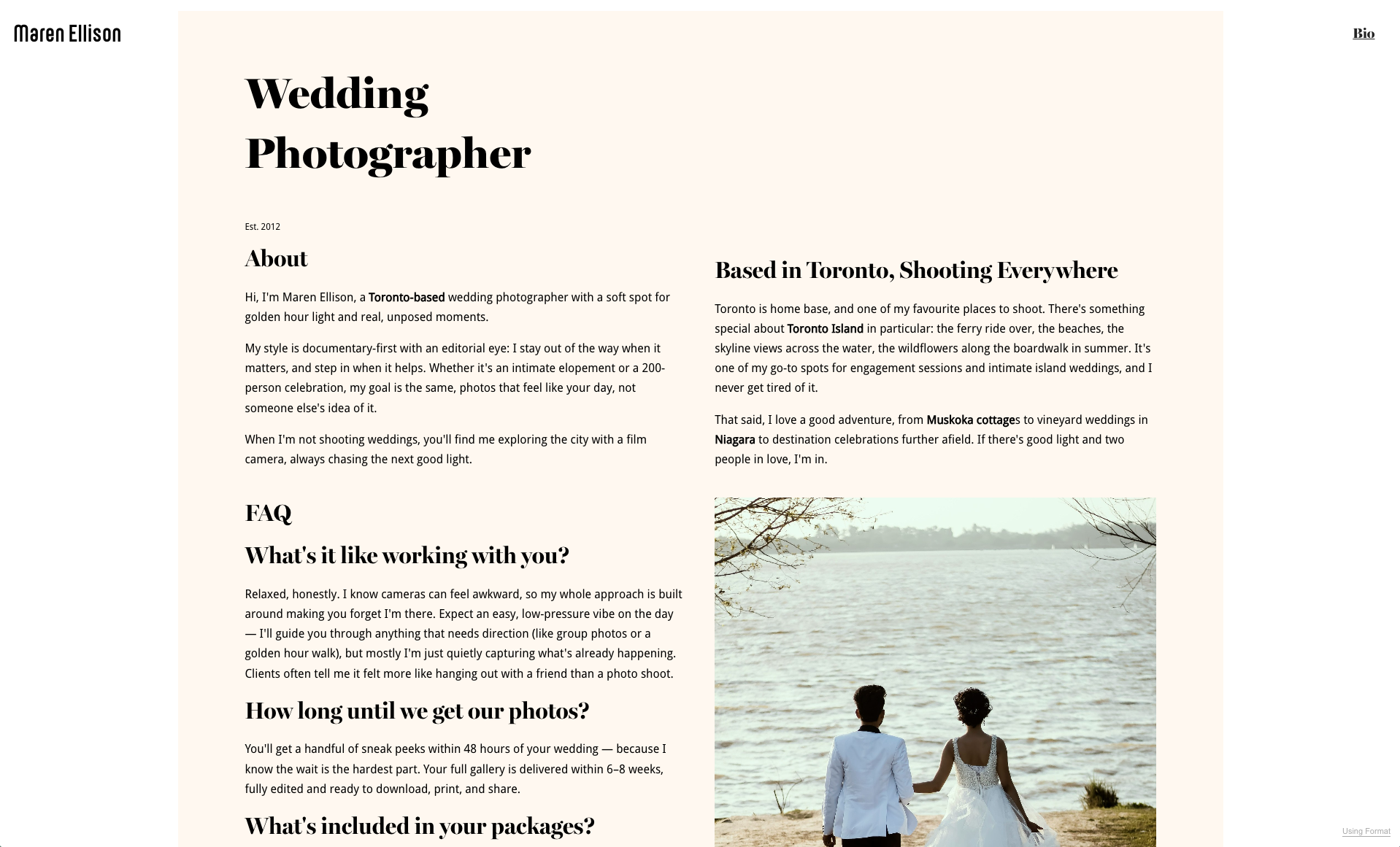
- Audit your portfolio for text content. Open your portfolio site and browse it with the images mentally removed. Is there enough written content for an AI to understand who you are, what you shoot, where you’re located, and why you’re credible? If not, start adding project descriptions, service details, and contextual copy.
- Rewrite your bio with specificity. Generic bios (“I’m a passionate photographer who loves capturing moments”) give AI nothing to cite. Rewrite yours with concrete details: your location, your specialty, your experience, and the types of clients you serve.
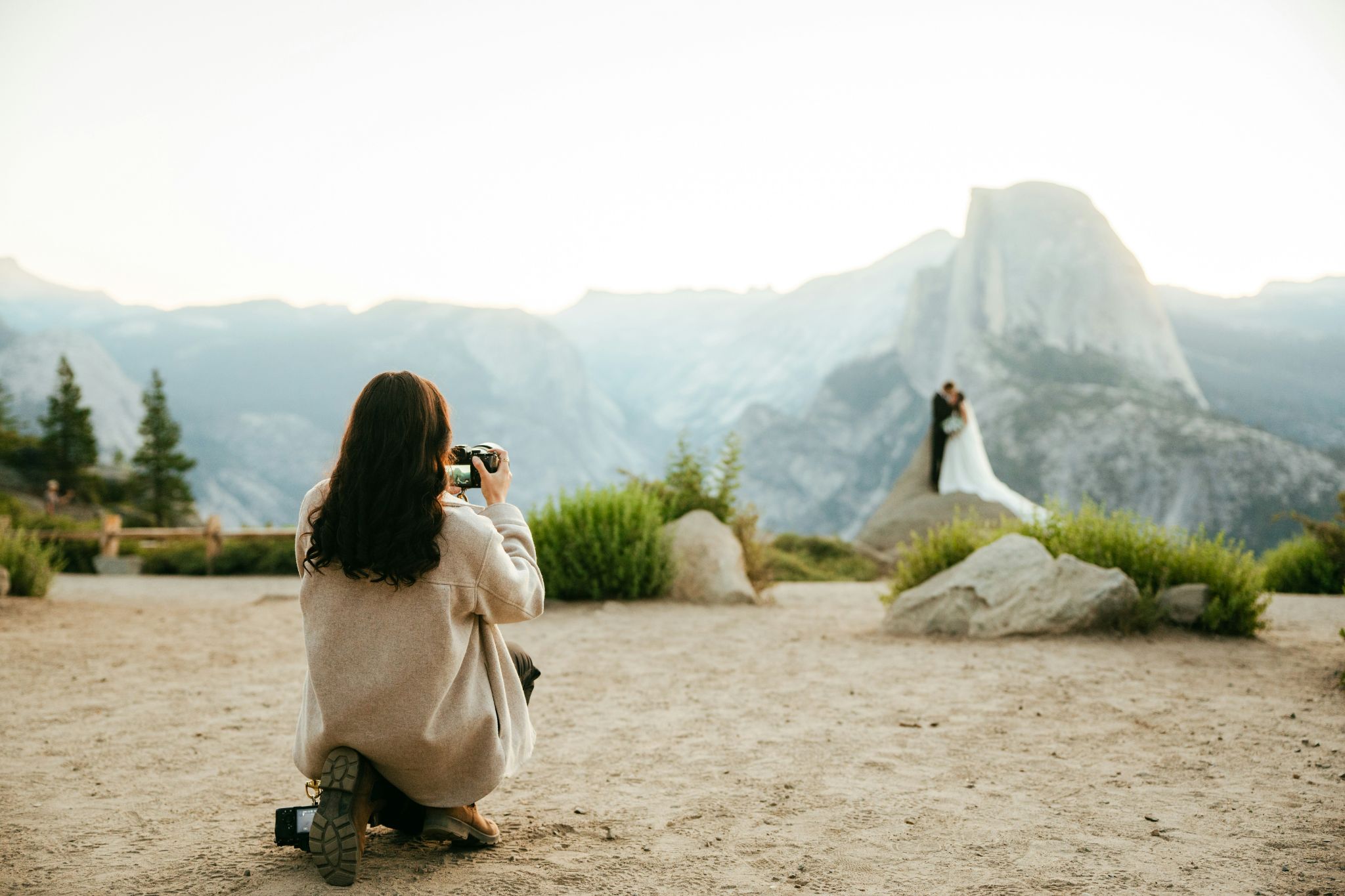
- Add or improve alt text on every image. Describe what’s actually in the image. “Bride and groom exchanging vows at Glacier Point, Yosemite, during a June elopement ceremony” is infinitely more useful than “wedding-photo-1.jpg.”
- Create location-specific and service-specific pages. If you serve multiple areas or offer distinct services, give each one a dedicated page with unique content. These pages become individual entry points for AI discovery.
- Add FAQ sections where they fit naturally. Answer the real questions your clients ask before booking. AI tools actively pull from FAQ-formatted content.
- Claim and optimize your Google Business Profile. This remains one of the strongest local signals for both traditional and AI search. Keep it current with photos, reviews, and accurate service categories.
- Publish content that demonstrates expertise. Blog posts about your process, venue guides for your area, behind-the-scenes breakdowns of shoots. This content builds the topical authority that AI systems reward. It’s also what potential clients actually want to read.
Put these steps to work on a platform built for creative professionals. Start free today.
What Your Portfolio Platform Needs to Support AI Discovery
Not all portfolio platforms are equally prepared for AI search. When evaluating whether your current platform supports modern discoverability, look for:
- Clean, crawlable HTML. AI crawlers need to access and parse your content efficiently. Platforms that render content primarily through JavaScript may create barriers.
- Built-in SEO controls. Custom meta titles, descriptions, URL structures, and heading hierarchy should be baseline features.
- Schema markup support. Either native structured data or the ability to add custom code.
- Responsive, mobile-first design. Google’s indexing is mobile-first, and AI tools follow suit.
- Fast load times. Performance affects both ranking and AI evaluation.
- Image optimization tools. Compression and proper delivery formats without sacrificing visual quality.
Format is built specifically for creative professionals, with Herramientas SEO, clean HTML output, and designer themes that balance visual impact with technical accessibility. For photographers evaluating their platform, the question isn’t just “does my site look good?” It’s “can AI find, read, and recommend my work?”
See how Format’s built-in SEO tools make your work discoverable. Try it free.
What Still Works from Traditional SEO
It’s worth being clear: AI search hasn’t made traditional SEO irrelevant. It’s layered on top of it. The fundamentals still matter, and photographers who skip them won’t benefit from any amount of AI optimization.
What continues to work:
- Keyword-informed content that reflects how real clients search
- Strong local SEO signals including Google Business Profile and consistent citations
- Quality backlinks from publications, vendor partners, and industry directories
- Mobile-optimized, fast-loading pages
- Well-structured portfolio pages with clear navigation and descriptive content
- Regular content updates that signal an active, current business
If you haven’t addressed these fundamentals yet, start there. AI search optimization builds on this foundation. It doesn’t replace it.
Preguntas frecuentes
Will AI search kill traditional SEO for photographers? No. Traditional SEO provides the foundation that AI search tools evaluate. The photographers who invest in both will have the strongest visibility. Think of AI optimization as a new layer, not a replacement.
Do I need to be on every AI search platform? Not directly. Most AI search tools (Google AI Overviews, ChatGPT, Perplexity) pull from publicly accessible web content. If your portfolio is well-structured, clearly written, and technically sound, you’re positioning yourself across all of them simultaneously.
How long until I see results from AI search optimization? AI Overviews and AI-powered search results update faster than traditional organic rankings. Changes to structured data and content clarity can start showing impact within weeks, though building genuine authority takes months of consistent effort.
Does my portfolio platform affect my AI visibility? Yes. Platforms with clean code, schema support, and proper crawlability give AI tools more to work with. Image-heavy sites with minimal text or poor HTML structure are at a disadvantage regardless of how beautiful the work is.