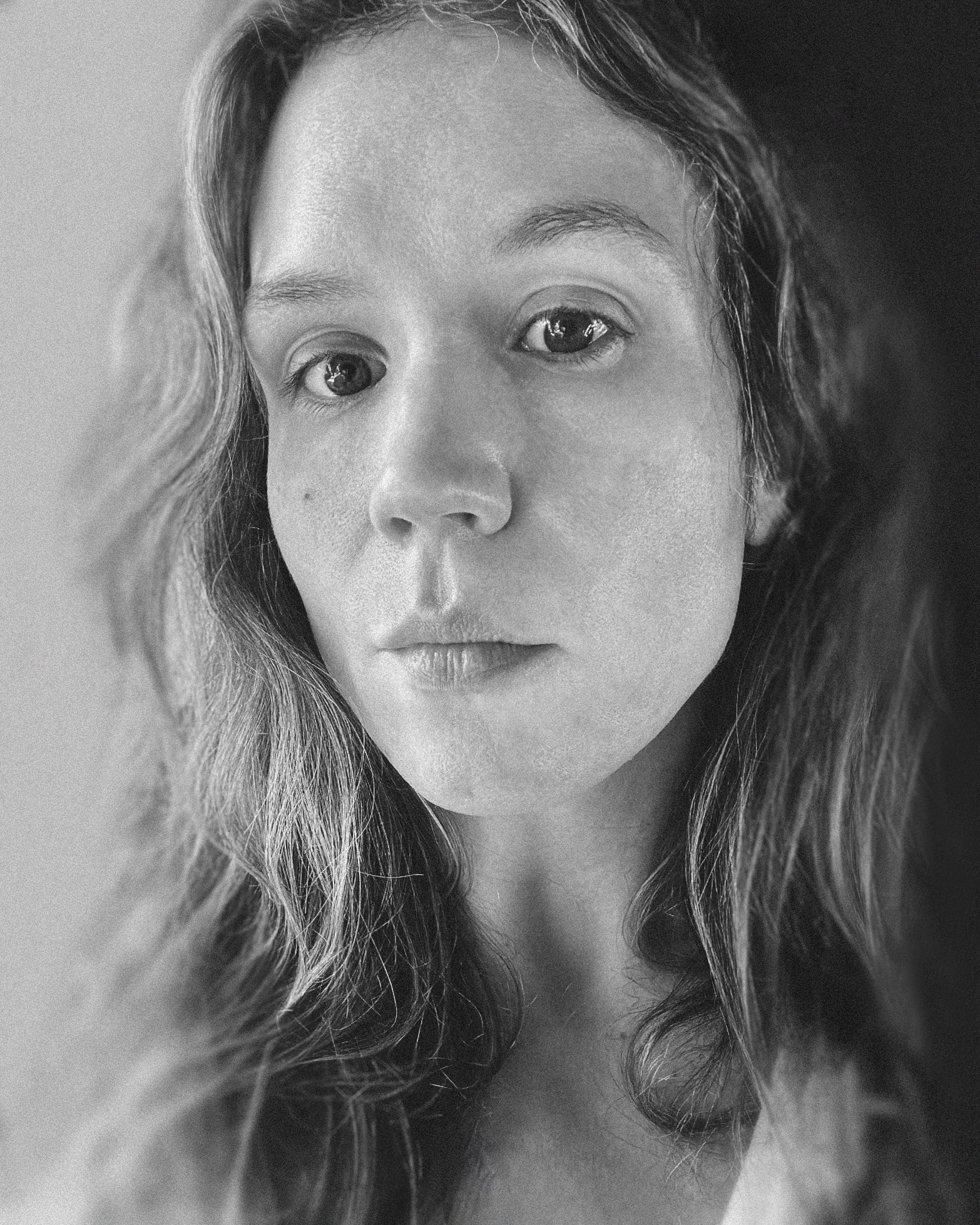


We look for ourselves in photographs, an exercise of self-consciousness and awareness we perform again and again. Marie-Laure Sorbac, in her self-portrait series “In the Mirror,” asks herself: “Do what I think and what I see define who I am?” This question is a driving force behind the work. In a dialogue with the camera she presents a duality, a conversation between her inner self and her external representation.
The Legacy of the Self-Portrait
Sorbac’s work carries something of the ghost of Francesca Woodman—a similar sense of surreal domesticity, of a body in motion and at rest within the confines of a room. Where Woodman’s work often felt like a fragile disappearance, her body and consciousness fading from view–the classic representation of absence and presence, here Sorbac’s presence is grounded, and defiant.


Her body is a confident and intentional vessel, moving through spaces that are at once familiar and strange. Sorbac is both actor and director, much in the tradition of other artists like Cindy Sherman, firmly present in a solid, if questioning, state. Sorbac uses the camera as a tool to explore, as she puts it, the “societal injunctions imposed on women,” and the performative nature of identity.

Born in France and educated in New York during the 1980s, Sorbac’s photographic journey has been a long and thoughtful one. Her photojournalistic background, with its emphasis on capturing a moment of truth, provides a fascinating counterpoint to this series, which deliberately questions the very notion of a single, objective truth in a photograph. This duality—the documentary gaze turned inward—is what gives her work its quiet power. She is a humanist photographer, but here, the humanity she explores is her own.

As a writer so familiar with the truth in the adage Escreva o que você sabe, I see a similar approach in Sorbac’s work. Photograph what you see. And we see ourselves so often.
Surrealism in Domestic Spaces
Her body is a subject, a tool, and a canvas, often partially obscured by light and shadow, or by the very objects of the room. She is seen, she occupies the space, but not always fully revealed.
The domestic spaces she photographs herself in—a bedroom, a kitchen—become stages.
In one image, she kneels, hands clasped in a gesture of prayer or supplication, a ray of light cutting through the darkness, illuminating a pile of discarded flowers.

In another, she sits at a kitchen table, a typewriter sitting in front of her–expectant of some action, her head resting in her hand in a pose of contemplation or weariness. These images are rich with symbolism, meditating on roles, on expectations, on the act of creation itself.
Metaphor and Archetype
The use of black and white film adds a timeless quality of the work, stripping away the distractions of color to focus on form, light, and shadow. It lends a classic, cinematic feel to the images, as if they were stills from a deeply personal, psychological film (a la Sherman’s Untitled Film Stills). This is photography as poetry, where the meaning is found not in a straightforward narrative, but in metaphor and archetypes used as a visually lyrical shorthand.
Ultimately, Sorbac’s work is an invitation to engage in her exploration. As her statement says, this work “delves into mental construction and the duality between perception and representation.” It asks us to consider our own fragmented truths and the ways we present ourselves.


To view more of Marie-Laure Sorbac’s work, visit her Portfólio Format.
Crie seu portfólio com o Format
Criador de portfólio on-line classificado como #1 pelos fotógrafos.
Colaborador
-

Julia Martin é uma artista e escritora interdisciplinar que mora em Montreal. Com mestrado em Artes Visuais e bacharelado em Fotografia, o trabalho dela já foi exibido no Canadá, China, França e Finlândia, incluindo várias residências artísticas. Ela já deu aula na Universidade de Ottawa, fez parte de júris de arte e tem quinze anos de experiência como fotógrafa freelancer. A prática artística da Julia pode ser descrita como "histórias tristes pontuadas por piadas"."
Embora às vezes seja o contrário.