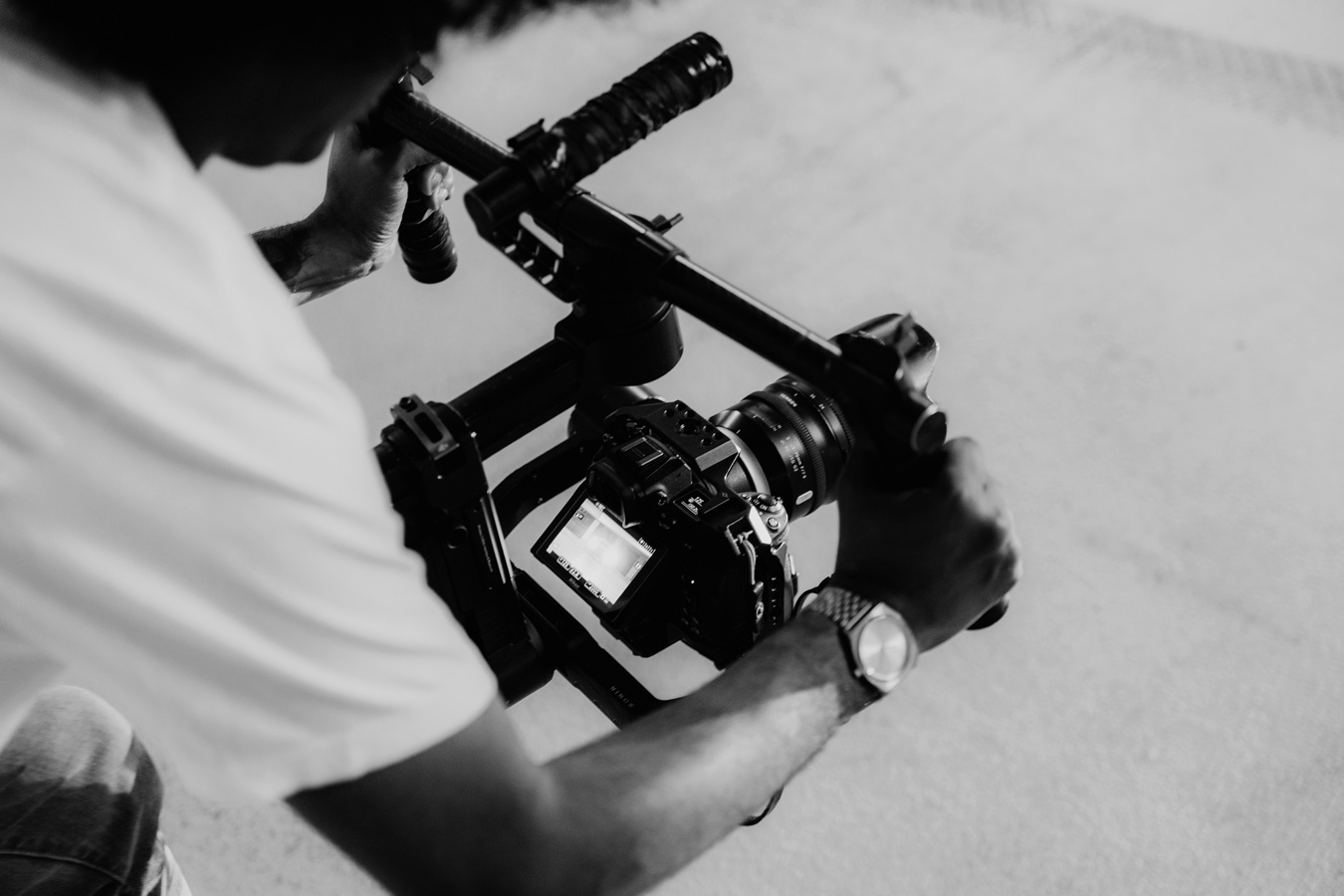


As photographers we often work in a world of single frames. We hunt for the decisive moment, compose our shots, and capture time with the click of a shutter. Yet often a compelling narrative requires more than just a single image—it relies on a sequence, a mood, and a narrative arc. As a photographer, I’m drawn to films for inspiration in my work, especially now as the line between still and moving images is blurring, and the label photographer begins to imply videographer.
Format’s new flex block video feature is a response to this creative evolution, allowing for a mixing and overlapping of media content within your portfolio.
Here are some of the best movies for visual artists and essential films for photographers that I found most impactful as a photographer drawn to films that understand the foundational medium either in their approach, or subject matter.
This list won’t have the standards– those lists already exist, these are movies every photographer should watch when they have exhausted the other lists. This list is my take on the top films for photographers where the directors understand the power of both still and moving images, or in which photography plays a crucial role in the narrative.
Civil War (2024) Dir. Alex Garland
Despite its name and implications within a highly divided political landscape, this is not a film about politics. Alex Garland is careful to keep the exact nature of the ideologies in opposition vague and without party affiliation.
This is a story about image-making, in which the values of documentary journalism are pitted up against the practice of content creation. Within that clash is a generational friction. The old guard of documentarians versus the new watch; a generation that documents everything.
Dunst personifies the genre of journalistic photography as an objective document of truth, a complicated, violent truth that has made her incredibly weary. Portraying a character based on photojournalist Lee Miller she carries the film, as a photographer heavy with the burden of her own archive.
The tension between the established and the new sees Lee’s counterpart in Jessie. The younger photographer who pushes her way into Lee’s band of travelling journalists. She works with a 35mm film camera, entirely impractical to the ways news is published now, it has Jessie chemically processing in the field and scanning with her phone. It’s a choice that feels more like an affectation than a genuine passion for a process she would never have learned as a first introduction to the medium. This is not the first instance in which the audience understands that Jessie willfully chooses style over sense.
Garland employs a perfect visual narrative device as the characters move within scenes of action and violence; following the release of a character’s camera shutter, their resulting photograph fills the screen. Speaking directly to photographers, Garland illustrates the different approaches the characters take; their angles, what they choose to photograph. We see in Lee’s images an attempt at some objective distance or humanizing context, and Jessie’s a confrontational, gonzo-style capturing of pain and fear.
The moments that Lee holds her camera still, leaving a scene undocumented, become all the more profound. Some may read this as a character giving up, as a photographer I see it as a character who has become more aware of what she is doing, its impact to the subject, the viewer and herself.
To photographers, especially, there is a clear thesis here about the morals, ethics, and methods of taking photographs during moments of human turmoil. The film’s pivotal sequence comes when Lee shows restraint, refusing to capture a photograph, while Jessie’s image-over-everything ambition leads to grim consequences. It’s a powerful morality play that makes us confront the essential question: what is the true cost of the image taken, and who is ultimately paying for it?
La Jetee (1962) Dir. Chris Marker
La Jetée is an essential film for photographers who are learning the history of the medium and filmmakers who love expanding their knowledge of influential films.
Photographer Chris Marker explores memory and the power of the singular image by making a film composed entirely of still photographs. Though one could argue every film shot on film is exactly that—a series of stills—Marker takes this to its conceptual extreme and the singular nature of the frames is emphasized. The film’s narrative is propelled not by a seamless flow of action but by a sequence of static, black-and-white photographs, each one a memory of the protagonist’s past or a vision of a potential future.
A film that sees time travel become a metaphor for nostalgia, sentiment and the power of the document of time. The film is centered on a man haunted by a single moment he witnessed at an airport as a child, a moment he must now return to in order to save the future of humanity. The still photographs act as a perfect stand-in for the way memory works—fragmented, powerful, and often tied to a single, indelible image. For photographers, this film is a powerful reminder that every single frame we capture has the potential to carry an entire story.
Memento (2000) Dir. Christopher Nolan
The twists and turns of Christopher Nolan’s film—co-written with Jonathan Nolan—are predicated on the unreliability of memory, or the absence of it. Guy Pearce’s Leonard suffers from a unique form of amnesia that prevents him from forming new long-term memories. Using tattoos, notes, and, most importantly, photographs, Leonard is searching for the person responsible for the death of his wife.
Central to the film is the reality that photographs can be both manipulated and used for manipulation. The content of a photograph can be staged or doctored, and the psychological and physical fallout from altered images can be devastatingly real.
For a photographer, Memento is a dark lesson in the nature of “truth.” The film’s fragmented, non-linear structure is a visual metaphor for a disorganized archive, forcing the audience to piece together the narrative from scattered, often misleading, clues. It reminds us that an image, when removed from its context, can be a dangerous, unreliable witness.
Special mention also for Oppenheimer, as a masterclass in storytelling.
You Were Never Really Here (2017) Dir. Lynne Ramsay
Director Lynne Ramsay is a master of atmosphere and the subtlety of expression, able to convey so much narrative with little dialogue. Breaking Ramsay’s films into still images shows her considered approach to composition as a storyteller. Though shot digitally, Ramsay borrows the aesthetic of film stock for colour and atmosphere (initially wanting to shoot on film, but with time limitations necessitating digital).
A haunting film about PTSD, and the affected former soldier left grieving the loss of identity, looking for and needing duty to keep himself from succumbing to his self-destruction. His mother provides enough of this impetus until the film’s events unfold, leaving him ultimately untethered and needing a way to serve. The film’s visuals are a masterclass in using colour and light to convey emotional states, something photographers can learn from directly. Ramsay uses saturated reds and deep blues to externalize the character’s internal turmoil, creating a familiar visual language as an emotional shorthand, one as powerful as the sparse dialogue.
Strange Darling (2023) Dir. Giovanni Ribisi
Giovanni Ribisi’s first foray into directing took an ambitious approach of shooting on film and telling a non-linear story. The look of the film is nostalgic and could be from any time in the last fifteen years. By choosing to shoot on film, Ribisi imbues the story with a timeless quality, a physical texture that is immediately evocative.
This deliberate choice highlights the contrast between the film’s classic aesthetic and its modern, fragmented narrative structure. For photographers, this film demonstrates the power of medium and how the choice of film stock can define the aesthetic, and impart so much of the emotional quality of an image.
The non-linear narrative, with its shifting perspectives and out-of-order scenes, feels like piecing together a story from two different photographers covering the same event from their own perspectives and biases—until they ultimately converge onto the same pivotal moments. This is one of the best films for visual artists working with film and looking for inspiration
Nothing (2003) Dir. Vincenzo Natali
As a proud Canadian, I’m mandated by law, to make sure that 35% of all the content I consume is Canadian, (I’m fairly certain it’s in our Constitution at this point), and I take my civic duty seriously.
Which works for me, as we’re a scrappy, low-budget powerhouse, and more interesting to me than filmmakers who perfectly execute a formula is the effort to do something different and weird. Director Vincenzo Natali, behind horror films Splice and Cube, is very good at weird. Here making a comedic departure in the film Nothing with one of the funniest, most appealing and effectively expository opening sequences of a film that I have ever seen. An animated collage of photographs depict the main characters, their relationship, and backstory, beautifully setting up a film that is truly great for the first two thirds, and goes a little off the rails in the last—again, I respect seeing something really different.
For photographers, this opening sequence is an inspiring example of visual storytelling. It demonstrates how a series of still photographs can be used in filmmaking—one of my first assignments in a film class was to do exactly that, and it’s a perfect example of what can be accomplished with a simple but creative use of your photographic archive.
The film narrative explores the complex relationship we have with places we occupy and the things we have, the wants, needs, jealousies and memories they carry, and what happens when they’re stripped away, what happens when bit by bit everything becomes nothing.
Cube (1997) Dir. Vincenzo Natali
A Vincenzo Natali double-feature, again, I wasn’t kidding about that CanCon mandate. This is one of the best examples of what a director can do with limitations, and by extension, what a photographer can do with limited space and budget. Using just one room, Natali used lighting and colored gels to make it feel like many, all contained in a cube structure of shifting rooms. Conceptually, think of it like a Rubik’s cube.
The rooms move and interlock by hatches at intervals that the protagonists trapped within can’t initially predict. The cinematography is claustrophobic at times; depth of field, camera lens, and low, colored lights are all used to denote change in character perspective and room. The VFX is surprisingly effective for 1997.
The characters all awaken with no recollection of how they came to be in their respective rooms. In need of food, water, and escape, they must traverse them if they have hope of surviving. Some rooms are deadly, others safe. Only the sequences of numbers at their port-door openings can indicate—if deciphered correctly. A narrative that implies an experiment on a grand scale. For lack of a better word, the vibe of this film stayed with me for three months, and I remember it truly as a single frame. It’s a testament to the director’s ability to create an unsettling atmosphere with very little, and is a must for fans of the horror-genre.
From Stills to Stories
The films on this list are a testament to the power of visual storytelling, whether through a single, static image or a seamless sequence of motion. For anyone interested in learning from cinema as a photographer, these selections offer profound lessons. From exploring themes in movies about photography to understanding visual composition in movies, each one provides unique and valuable insights.
Whether you’re a photographer expanding your practice or a filmmaker representing your best work online, Format’s new flex block video feature will seamlessly integrate video into your online portfolio, creating a dynamic and immersive experience for your audience. From short-form clips to full-length narratives, the ability to tell your story your way has never been easier.
Start building your next visual story with Format with a free 14-day trial.
Related Articles:
10 Essential Films for Filmmakers
5 Must-read Books for Every Artist
8 Inspiring Film-Based Portfolio Designs for Filmmakers
Contributor
-

Julia Martin is an interdisciplinary artist and writer based in Montreal. With an MFA in Visual Arts and a BFA in Photography, her work has been exhibited across Canada, China, France, and Finland, including multiple artist residencies. She has taught at the University of Ottawa, served on art juries, and has fifteen years of experience as a freelance photographer. Julia's own artistic practice could best be described as "sad stories punctuated by jokes."
Though sometimes it's the other way around.